
The Problems Facing The Current NFT Market

The NFT (Non-Fungible Token) market has grown rapidly in recent years and is expected to be a technological trend in the future. However, to develop sustainably and attract more participants, this market still faces some challenges that need to be overcome.
The article will analyze some of the major problems facing the NFT market now and how they affect the current state of the NFT Market
The NFT Market’s hurdles to growth
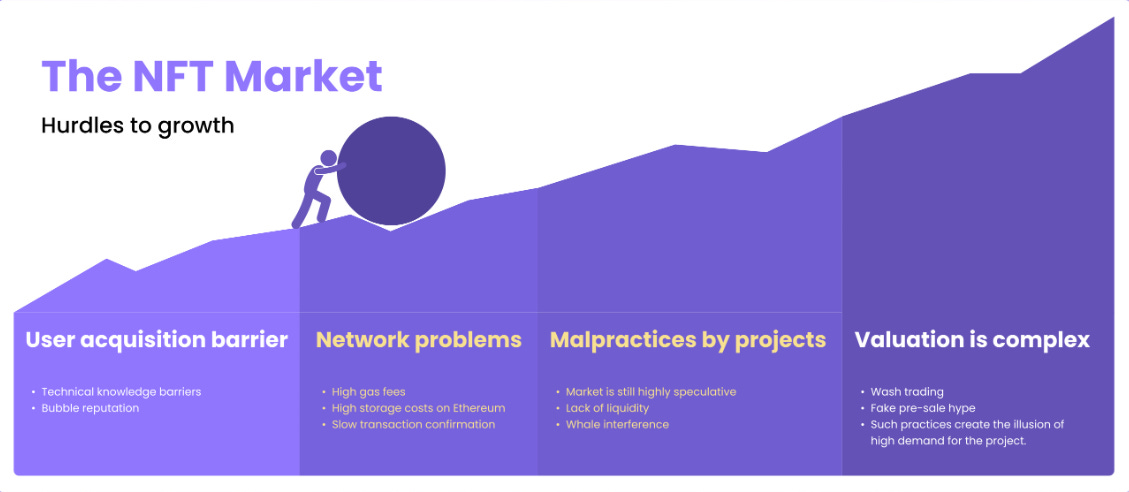
User acquisition barrier
Technical knowledge barriers
Users in the NFT space often face a lack of financial incentives and technical knowledge, which can discourage their participation. Unlike traditional markets where artists earn royalties from resales, NFTs currently do not offer this benefit.
As a result, many creators and collectors miss out on potential profits from secondary sales. This lack of financial rewards limits the appeal for users to engage in the NFT market and hinders its growth.
Bubble reputation
NFT bubbles can occur when there is rapid growth in prices driven by hype from new entrants rather than fundamentals. Bubbles form as speculation runs high from lack of market understanding. A bubble refers to sudden unsustainable price gains exceeding an asset's value, though not all necessarily lead to crashes. NFT values rely on cultural, reputational and community factors beyond price alone.
Network problems
High gas fees
The high transaction costs associated with using the Ethereum blockchain pose a barrier to entry for many seeking to participate in the NFT market. Moving assets on Ethereum results in significant "gas fees" which must be paid. For artists and collectors, these steep prices mean only a narrow group can realistically trade and sell their works.
With gas fees so elevated, the average person faces financial hurdles in engaging with the NFT ecosystem for buying, selling or exchanging digital collectibles and creative works. The high costs essentially limit the potential customer base and greater adoption, working against broader access and democratic participation in the growing industry.
High storage costs on Ethereum
The Ethereum whitepaper states that storing 256 bits of data costs 20,000 gas units, meaning 1 kilobyte would equate to around 640,000 gas or over $250 currently.
As Ethereum has grown in popularity, so too has the volume of transactions clogging up the network at times. This surge in demand causes congestion that translates to processing delays as well as exorbitantly high transaction fees and storage costs on Ethereum during crowded periods.
Slow transaction confirmation
Similar to other issues, as demand on the Ethereum network increases, processing times may take longer. This results in slow transaction confirmation. This is also a problem that causes a lot of trouble for users.
Malpractices by projects

Market is still highly speculative
The NFT market remains highly speculative due to various factors. There are no standardized valuation metrics, as prices depend on perceptions of scarcity and demand that can fluctuate. NFT prices also experience boom and bust cycles fueled by speculation. While potential applications exist, their real-world use cases have yet to be proven at scale.
Additionally, secondary markets for NFTs lack liquidity compared to traditional assets. Without demonstrated utility and transparent pricing discovery, speculation continues to influence valuations in the uncertain marketplace.
In summary, the NFT sector will retain a speculative nature until applications mature and widespread adoption reduces volatility over the long run.
Lack of liquidity
The NFT market is experiencing a shortage of liquidity. This common challenge in the NFT space is the limited availability of buyers and sellers, which can hinder the smooth flow of market transactions.
Whale interference
Whale activity has had significant impacts on the volatile NFT market. These wealthy investors are able to manipulate prices through large purchases and sales that dramatically swing values.
Some whales also orchestrate pump and dump schemes by coordinating hype around certain NFTs before selling for profit. Their outsized influence introduces enhanced volatility and uncertainty as prices rise and fall precipitously on whale transactions. This undermines fair pricing discovery and leaves smaller players vulnerable.
Valuation is complex
Wash trading
NFT wash trading occurs when traders buy and sell the same assets between their own accounts to artificially inflate trading volumes and interest in a project. This market manipulation technique aims to mislead legitimate buyers into believing an asset is highly sought after, when in fact the demand is inflated.
Traders may use multiple accounts or collude to repeatedly trade the same NFTs back and forth. Such activity can exaggerate valuations, mislead investors into overpaying, and undermine marketplace integrity if the inflated demand is later revealed. It risks creating bubbles that burst when true demand is lower than portrayed.
Fake pre-sale hype
Fake pre-sale hype can have significant detrimental impacts on the NFT marketplace. Exaggerated and unsubstantiated claims about future partnerships, gains, or other milestones artificially inflate valuations to unrealistic levels not supported by legitimate potential or demand.
This sets the stage for unsustainable price inflation fueled by unwarranted optimism. The hype thus enables pump and dump schemes where profiteers sell inflated assets for big gains. When projects inevitably fail to deliver on their outsized promises, it erodes confidence in the sector and deters new adoption. Not only does this undermine integrity and mislead investors, it also introduces damaging volatility as prices are pumped far above reasonable levels before inevitable corrections.
In general, generating unmerited buzz without substance undercuts a fair and sustainable market based on real utility and fundamentals.
Such practices create the illusion of high demand for the project.
Current state of the NFT market
According to dappGambl:
The NFT market is going through hard times, as 69,795 out of 73,257 digital collections have a market cap of 0 Ethereum.
Only 20% of the identified collections have full ownership. It means nearly 80% of all NFT collections "have remained unsold."
Additionally, more than 1,600 Top NFTs listed are dead:
18% of NFT are worth $0.
$5-$100 most common NFT Price.
These figures show a challenging landscape for the NFT market, with a large number of collections having a market cap of 0 Ethereum, low ownership rates, a significant percentage of unsold collections, and a notable presence of inactive or dead NFTs. The common price range between $5 and $100 implies a concentration of NFT values within this bracket.
Overall, the NFT market faces difficulties with widespread unsold collections, ownership concerns, and the presence of inactive or undervalued assets.
Conclusion
The NFT market needs solutions to address those issues that can affect the sustainable development of the NFT market in particular and the Crypto market in general.
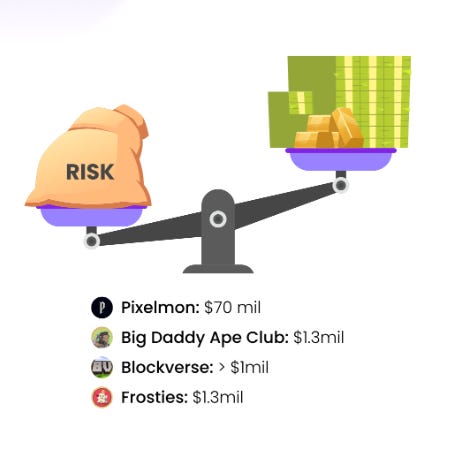
NFTs can be a high-risk, high-reward opportunity for investors. Despite the potential for significant returns and access to unique assets, investors must also be aware of the risks and challenges involved. Investors need to research carefully and only seek advice from reputable experts in the field before deciding to invest.
About Demask Finance
DeMask Finance is A on-chain Automated Market Makers (AMM) Protocol for Trading between NFTs and ERC20 Token.
Website: https://demask.finance/
Twitter: https://twitter.com/DemaskFinance
Telegram: https://t.me/DemaskFinance